
How to Search Criminal Dockets
No single countywide query form covers every criminal case in Loving County. So begin with the right court. Felonies usually land in the 143rd Judicial District Court. Class A and B misdemeanors go to the constitutional Loving County Court, while fine-only Class C matters belong to the Loving County Justice Court. The district page and the County Court page post local docket links, but those PDFs are dated calendars rather than full criminal histories.
Work the chain. A Loving County docket search can move from the local calendar to Texas re:SearchTX, a phone call, the counter, or a written request by mail. Carry the same case number through every step. The Loving County & District Clerk keeps both district and County Court files. Justice Court staff handle JP cases. For district settings, the court administrator can confirm details, though copies still come from the clerk.
- Identify the court from the notice, citation, or offense level.
- Check its official docket for the relevant date.
- Search Texas re:SearchTX if the case is integrated.
- Call or visit the clerk if a result is absent or unclear.
- Request the exact docket sheet, order, or filing and confirm its fee.
Loving Criminal Docket Channels
Each channel answers a different question. A posted Loving County criminal docket works best when you need a setting on that list. re:SearchTX may offer eligible case metadata, filings, text, and hearings, limited by public registration, integration, and a security matrix. For current status, a specific order, or certification, go straight to the clerk.
| Channel | Best use | Limit |
|---|---|---|
| Local PDF | Posted hearing | Snapshot only |
| re:SearchTX | Integrated cases | Coverage varies |
| Clerk | Status and copies | Right court required |
Texas has no one public portal for every trial court. A missing result can mean limited coverage, sealed access, the wrong court, or a search mismatch. It does not mean no record exists.
What a Criminal Docket Shows
The district and county calendars use a compact local layout. A header names the court, judge, date, and time. Each row can carry the case number, party, attorney or bondsman, offense date, action, offense, and bond fields. That is enough to identify a setting. It does not prove guilt, a final result, or current bond status.
| Case number | The file key for each later request. |
|---|---|
| Date and time | The posted setting, subject to change. |
| Action | The scheduled purpose, not always the result. |
| Offense | The listed charge, not proof of guilt. |
| Bond fields | Local entries that require clerk confirmation. |
The official file and the latest order control. Treat the public calendar only as a lead to those court records.
Loving Pretrial Codes in Context
Sample entries include CPL, DEF, BND, and Bond Type fields. Their placement points to court-management data. But no official local key explains them. Never guess at a row value. Ask the clerk how the court uses an abbreviation in that case.
- Setting
- A scheduled court event.
- Pretrial
- A stage before plea or trial.
- Disposition
- The formal resolution of a charge or case.
- Expunction
- A court process that can restrict qualifying criminal records.
Never read one field alone. Pair the case number with the latest order, the clerk's status, and the next setting.
Stages on a Criminal Docket
A criminal docket logs events as a case moves through court. The path varies with the charge, plea, motions, and court. District felony work can include a grand-jury step. County and JP cases follow the process tied to their own jurisdiction. A pretrial list captures just one point in that sequence.
Docket flow: Filing › Arraignment › Pretrial › Plea or Trial › Disposition › Sentencing
Arraignment covers the charge and plea. A continuance just moves a setting. Neither term means dismissal; later orders show what the court actually did. The Loving County case search process helps trace those entries once the trial court is known.
Loving Pretrial Is Not Final
The district sample is headed as a pretrial docket. That label matters. Someone listed there may later plead, go to trial, or get a new setting. The case could also be resolved by an order the calendar never shows. The action line only explains why the matter landed on that list. Without the filed order or clerk confirmation, it is not a final result.
Quick answer: A Loving County pretrial docket proves a posted setting, not the final outcome.
Which Court Holds Criminal Dockets
The 143rd Judicial District Court serves Loving, Reeves, and Ward Counties. It takes Loving County felony matters. Its ordinary administration office is in Monahans. The Loving County Court handles county-level misdemeanors. Fine-only Class C and traffic cases generally run through the countywide Justice Court.
Routing follows the case notice and number. Ask the District Clerk for a district file. Ask the administrator for its setting. County Court records go through the County Clerk path. Justice Court citation status belongs with JP staff at 432-286-9544. Court staff can explain process but cannot give legal advice.
Loving Multicounty Hearing Venues
A Loving County caption does not promise a Mentone hearing. The 143rd District Court spans three counties. The sample even includes an action set for a Ward County hearing. The official 143rd court page lists its Monahans office plus a Loving office. So file custody and scheduling contacts can differ.
Confirm venue before you travel. Start with the setting notice, then call the administrator at 432-943-2749 extension 5. The clerk remains the source for the case file. An old calendar address should never override a later notice.
The district's annual trial schedule adds one more layer. It lists jury weeks and grand-jury dates by county, with a warning that changes may occur. A jury week is a block of court time. It is not proof that one named case will be tried then. A grand-jury date likewise says nothing about whether a specific charge produced an indictment. Match every schedule lead to the case number and a current notice from the court.
Loving Criminal Docket Image
The official Texas expunction source shows why an online criminal docket can never be treated as permanent or complete.
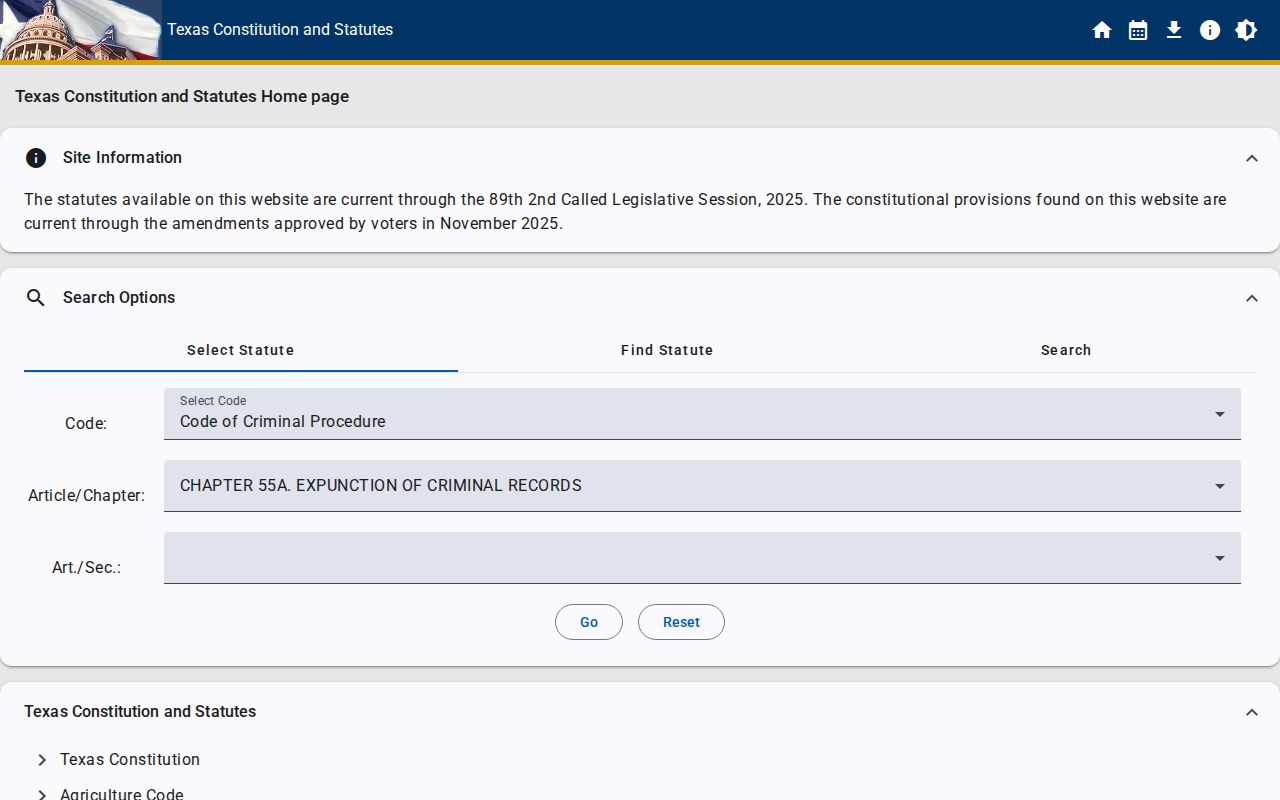
The source view shows an access limit without naming anyone tied to a Loving County criminal docket row.
Loving Clerk Request Checklist
Mozelle Carr serves as the Loving County & District Clerk. The office sits at PO Box 194, 100 Bell Avenue, Mentone, TX 79754. Call 432-309-9500 extension 6, or fax 432-789-2194. Hours run Monday through Thursday, 8:00 a.m. to 5:00 p.m., and Friday, 8:00 a.m. to noon.
- Name the court and county.
- Give the full case number.
- Name the docket sheet, filing, or order.
- Choose plain or certified copy.
- Confirm fee, redaction, and delivery.
The clerk takes requests by mail, phone, counter, fax, and a contact form. Hold back sensitive details until staff ask for them through a channel that fits.
Loving Calendar Versus Case File
Three public records do three different jobs. A posted docket lists hearings. An OCA report counts activity in the aggregate, while the clerk file holds pleadings and orders the court can release. Neither one can stand in for the other: a PDF row count is not the full caseload, and an OCA total will not show any person's case result.
| Record | Answers | Cannot prove |
|---|---|---|
| Posted docket | What was set | Final outcome |
| OCA report | Aggregate workload | Individual status |
| Case file | Filed events | Sealed content |
The same caution applies once a case leaves the trial court. An appellate entry tells you review was requested, nothing more. It does not confirm the judgment was affirmed, reversed, or changed. A federal criminal matter tied to Loving County belongs to the Western District of Texas. You reach it through PACER or CM/ECF, not the county clerk's docket path. Read the court named on the filing first. Then stay inside that court's own record system.
Save the dates with any result you keep. Note the PDF title, the listed court, the hearing date, the access date, and the case number. Add the case number too. That short log helps you spot a later reset or new order. It also keeps an older Loving County calendar from blending into a current clerk response. Your log guards against that mix-up on the same court docket.
Public Access and Sealed Criminal Dockets
The Texas Judicial Branch splits case records from administrative judicial records. The Texas Public Information Act does not govern adjudicative files the way it covers many agency records. Rule 12 handles certain administrative records, while the clerk or court process controls the criminal file itself.
Key rules:
Judicial Branch Open Records Policy explains the Rule 12 distinction.
Family Code Chapter 58 protects juvenile information.
Code of Criminal Procedure Chapter 55A governs expunction.
Sealing, expunction, confidentiality, redaction, and portal security can each block access. Treat a missing item as not viewable through that channel, not as nonexistent, and never republish identifying Loving County docket rows.
Loving Appellate Docket Follow-Up
An appeal opens a docket of its own. The Texas appellate search filters by trial county and case number. The Eighth Court of Appeals hears Loving County appeals when it has jurisdiction. Further criminal review goes to the Texas Court of Criminal Appeals as allowed.
Keep both case numbers handy. The appellate docket does not copy the whole trial file. Request each record from its own clerk. Search fields cover case style, filed-date range, attorney or bar number, and inactive status. The originating trial court is a field too. Start with the Loving trial-court number when you have it. Then check whether what you opened is an opinion, order, brief, or docket entry. Each plays a different role in the appeal.