
The Loving County Court Calendar
There is no single master calendar for Loving County courts. Instead, each court posts its own material. The 143rd Judicial District Court page carries district docket and schedule links. The Loving County Court page posts a county docket. County Court convenes on the second Wednesday of each month. The Justice Court page offers forms, office contacts, and monthly reports, though those reports are aggregate statistics rather than hearing lists.
Each type of posting answers a different question. A daily docket lists matters set for a stated date and time. A jury-week schedule reserves blocks for trial work. A grand-jury date concerns grand-jury activity only; it does not show that a named case will be heard. Monthly Office of Court Administration reports count activity after the fact. None of these alone is a full case history.
Loving County Jury-Week Calendar
The official 2026 trial schedule lists Loving County jury weeks. They begin March 30, June 1, August 31, and November 30. It also lists grand-jury settings for Loving. Those fall on January 14 at 9:30 a.m. and July 2 at 2:00 p.m. The document warns that changes may occur.
A jury week is a planning block, not individual notice. It does not prove every case on a prior docket will reach trial that week. A grand-jury date is likewise just a lead about a date and time. Ask the court administrator whether a matter is set, reached, reset, or assigned elsewhere. Keep the file name and access date. Include them with anything you save.
Match each schedule to the right court too. The annual district schedule belongs to the multicounty 143rd Judicial District Court. It does not replace the constitutional County Court's monthly practice. It does not replace a Justice Court appear-by date either. That date is printed on a citation or form. Someone holding a County Court notice should not assume a district jury week applies. A person with a JP citation should do the same. Follow the court named on that document. This court-first check keeps a real date from landing on the wrong Loving County matter.
Calendar distinction: A docket date is a listed setting, a jury week is a trial block, and a grand-jury date is neither a public trial nor a final case result.
How to Find Your Court Date
Begin with the paper in hand. That means the citation, notice, bond paper, pleading, or prior order. It should name the court. It may carry a case number. From there, work every Loving County calendar channel you can. Online results help. Still, clerk confirmation is the safest final check before you rely on any court date.
- Check the district or County Court page for a current docket PDF, or search the Hearings view in re:SearchTX if the case is integrated and public.
- Match the full case number, court, date, time, and setting type. Do not rely on a similar name alone.
- For district scheduling, call the 143rd administrator at 432-943-2749 extension 5. For County Court records and dates, call the Loving County & District Clerk at 432-309-9500 extension 6.
- For Justice Court, call 432-286-9544. Ask staff to confirm both the date and current hearing site.
- Check any courthouse or courtroom posting, consult counsel if represented, and confirm once more before travel.
The clerk counter sits at 100 Bell Avenue in Mentone. Posted hours run Monday through Thursday, 8:00 a.m. to 5:00 p.m., and Friday, 8:00 a.m. to noon. Holidays and court work can affect access, so call ahead.
Loving County Calendar Venue Checks
A Loving County case does not guarantee a Mentone hearing. The official 143rd District Court page describes a multicounty court. It serves Loving, Reeves, and Ward Counties. Its usual administrative office sits at 400 South Allen, Suite 200, in Monahans. A district pretrial docket even referred to a hearing in Ward County. Confirm the site with the administrator rather than inferring it from the caption.
Justice Court carries its own risk. The current county page lists the Loving County Community Center at 104 West Barstow Avenue and also retains courthouse directions, while an older form refers to the Hopper Annex. It also retains courthouse directions. An older form refers to the Hopper Annex. Those sources are not synchronized.
The courthouse address has a wording split of its own. Current clerk material says 100 Bell Avenue; the legacy county page says 100 Bell Street. The labels may point to the same courthouse area. Do not silently pick one when the hearing notice names another site. Read the newest order or citation. Compare it with the current court page. Ask staff to confirm the physical entrance. That matters in Loving County, where district administration, clerk custody, and the actual hearing room can sit in three different places.
143rd District Court Administration
400 South Allen, Suite 200
Monahans, TX 79756
432-943-2749 ext. 5
Use for district setting and venue confirmation.
Before you appear, verify the court, building, room, time, and attendance method. Remote attendance is never promised.
Reading a Court Setting
A posted docket identifies a setting, not every filing or outcome. Read the heading first. It gives you the court, judge, date, and time. Then match the case number. Fields such as party, attorney or bondsman, offense date, action, offense, and bond can separate similar entries. Do not republish private names or sensitive row data.
| Date | The calendar date printed on the source, subject to a later reset. |
|---|---|
| Time | The listed docket or setting time, not a guarantee of the exact call time. |
| Courtroom | The announced room or venue, which should be confirmed for district and JP matters. |
| Judge | The presiding judge shown. Conflicting official district pages make current confirmation wise. |
| Setting Type | An event such as pretrial, hearing, trial, or grand jury, not the case result. |
Local dockets also show CPL, DEF, BND, and Bond Type fields. Those are docket codes, not verdicts. If a code is unclear, ask the clerk what it means in the current court system.
Loving County Second-Wednesday Calendar
Loving County's constitutional County Court runs its docket on a second-Wednesday rhythm each month. Treat that as a planning clue only. Any given case may be reset, specially set, or placed on a different calendar entirely. If your address changed or you need a docket date, call the clerk.
One official page lays out that schedule. It also gives the clerk's instructions. That page is the County Court source. Read it before relying on the pattern for a court date.
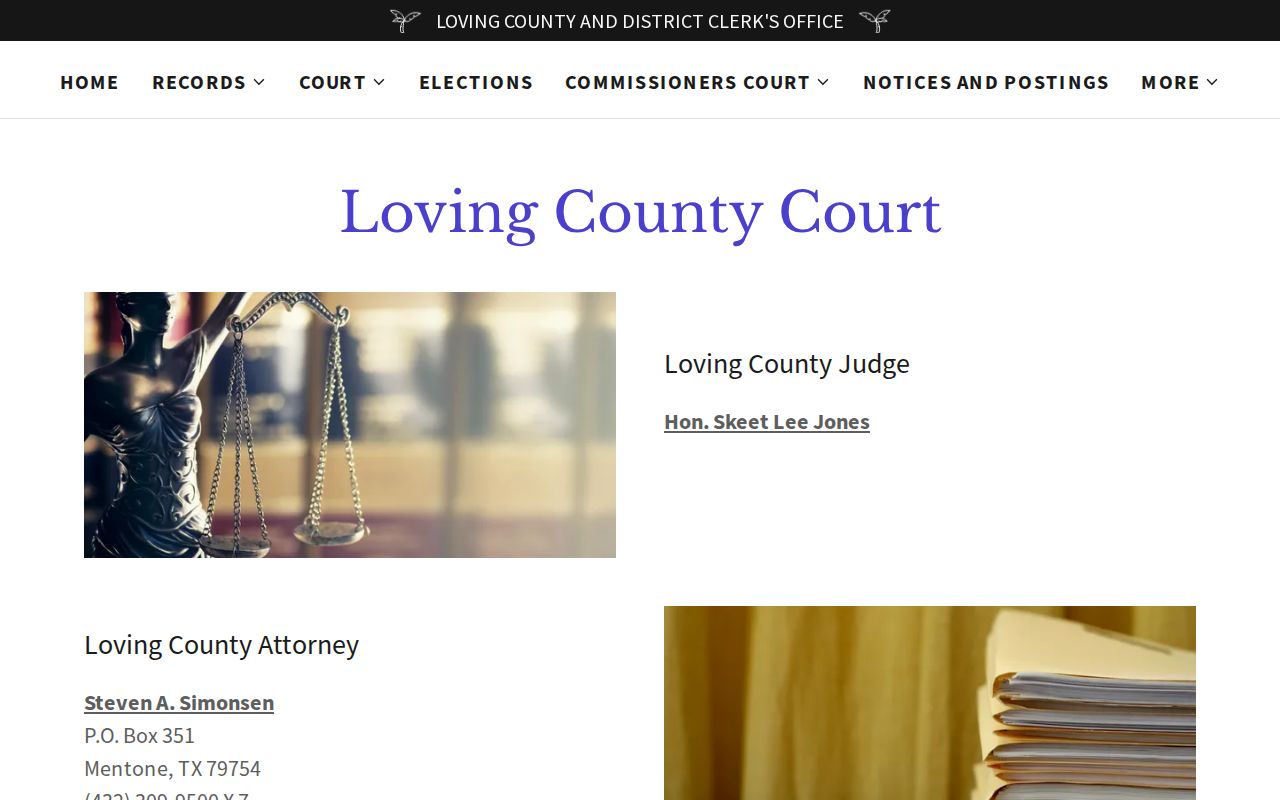
That page is the official channel. It does not replace a live docket or a clerk's confirmation for one hearing.
Resets, Continuances, and Cancellations
Some vocabulary helps here. A reset moves a setting to a new date. A continuance postpones a proceeding by court order or approval. A cancellation removes an event, though it does not dismiss the case by itself. A PDF can stay online after a change, and statewide data may lag behind the local system's update cycle.
So verify in order. Check the latest order or notice first, then compare the current docket page, then call the records clerk or scheduling office. A represented party should also contact counsel. Silence, a missing row, or an old PDF never means no appearance is required. The court's instruction controls.
Note: Save the source URL, file name, and access date so a later schedule change can be traced.
Loving County Calendar Snapshots
A local docket PDF is a snapshot, nothing more. The district sample was a one-day pretrial list dated March 21, 2025. The County Court sample was a two-page hearing list dated April 16, 2025. Neither file shows how many cases are open overall. Other dates, civil calendars, probate settings, sealed matters, and later changes may exist.
OCA monthly reports are a different animal. They count pending matters, filings, dispositions, appeals, collections, and other activity by category. They will not tell a named person when to appear. Use a posted docket for a setting lead. Turn to the clerk file for the record and the court office for current schedule control.
The distinction matters even in a county this small. Recent Justice Court reports carry substantial traffic inventory plus show-cause, appeal, disposition, and collection fields. Those figures describe workload under OCA reporting definitions. They cannot become a live hearing list or a formula for one person's balance. Finding a monthly PDF is not the end. You still need the citation, case number, and Justice Court clerk to get the next setting. Keep the report month whenever those public statistics are cited.
Loving County Date Verification
Before calling, gather a few things. Get the court name, full case number, party name, prior date, setting type, and any notice. Ask staff to repeat the date, local time, building, and room. Also ask whether an in-person appearance is required. If the setting moved, ask whether a written order or updated docket exists. Staff can explain schedule facts and filing steps. They cannot choose a legal course for you.
The Texas court-search FAQ confirms something important. No single portal covers all trial courts. re:SearchTX is a search layer, not proof that every Loving County hearing has been integrated. A missing result means you check with the office that holds the record.
Split your calls the right way. Use the clerk for the record and the court administrator for district scheduling. Loving County combines the elected county-clerk and district-clerk roles in one office. Even so, the records stay organized by court and case type. Naming the 143rd District Court or Loving County Court when you call cuts the chance of a wrong calendar match. Justice Court keeps its own clerk path. If an online result and a paper notice disagree, report both dates and ask which source controls.
What To Do If You Miss a Setting
Act at once. Contact the court named on the notice and give the case number. Ask whether an order, warrant, bond action, show-cause hearing, or new date was entered. Loop in counsel if you have one. Do not head to a site taken from an old form. Justice Court venue sources conflict.
Missed a Setting? A missed appearance can lead to a warrant, bond consequences, show-cause hearing, or other court action.
Call the correct Loving County office now and ask for the current status and next setting.
A licensed attorney can advise what response fits the facts; court staff cannot give legal advice.
Write down the date and time of your call, and keep any new written notice you get from the court. Only the court itself can tell you what took place in the case.