
How to Get Court Records
Access starts with the office that holds the file. That is not a statewide records sweep. For a 143rd Judicial District Court or constitutional County Court file, contact Mozelle Carr, Loving County & District Clerk. Justice Court clerks keep that court's citation, Class C, and limited civil files. Texas re:SearchTX may include an eligible integrated case. Still, it does not promise every Loving County court record or image.
- Identify the court, case type, and exact item, such as a pleading, order, judgment, docket list, or case register.
- Use the full case number when known. Otherwise give an approximate filing or hearing date and enough case detail for a focused search.
- Check Texas re:SearchTX, then confirm the result with the correct Loving County court record custodian.
- Request access by phone, at the counter, through the clerk contact form, or in writing by mail. State whether a plain or certified copy is needed.
- Confirm availability, redaction, delivery, and the current fee before sending payment or original material.
Mail a Loving County court records request to PO Box 194, Mentone, TX 79754. Prefer to hand it over in person? The clerk takes walk-in requests at 100 Bell Avenue. The current office listing confirms that. A quick phone call ahead is wise if your timing is tight.
Loving County Record Custodians
One elected official holds both clerk jobs in Loving County. The County Clerk and District Clerk records stay separate. District Clerk files belong to the 143rd Judicial District Court. The County Clerk keeps the constitutional County Court's records. Those files can include criminal, civil, probate, and juvenile matters that court handles. Name the court when you ask. The Justice Court has its own clerks. Marina Fuentes and Veronica Aguilar manage traffic, fine-only criminal, small-claims, and debt-claim files.
Court dates work differently. Need a setting or venue confirmed in the 143rd District Court? Call the court administrator in Monahans at 432-943-2749 extension 5. Justice Court questions go to 432-286-9544. For district and County Court records, the clerk's line is 432-309-9500 extension 6. The administrator schedules. The clerk remains the office that holds the docket and case files.
Loving County & District Clerk
100 Bell Avenue
Mentone, TX 79754
PO Box 194
432-309-9500 ext. 6
Fax: 432-789-2194
Types of Court Records
Ask for a document, not just a case. That is the smart way to request a Loving County court record. The docket PDFs posted locally are hearing lists. They are snapshots of a calendar. They can help you find a case number or a setting date. They cannot show every filing. They never prove an action is final. The case file itself holds the fuller procedural story behind any court docket entry.
- District and County Court docket sheets or posted hearing lists
- Petitions, answers, motions, and other available pleadings
- Signed orders, judgments, and available disposition records
- Probate papers and inventories that are open to public inspection
- Justice Court traffic, Class C, small-claims, and debt-claim case files
- Transcripts or reporter materials requested through the court-specific channel
Deeds, liens, and plats live elsewhere. The county-linked LovingTXRecorder system covers recorded documents only. It is not a source for Loving County court records generally.
Specify Loving County Court Records
Getting the description right keeps a Loving County records request from landing in the wrong office. Give the court name, the case number, the case type, a rough date, and the document wanted. No case number? A party or business name may still work. Skip sensitive material like birth dates and driver-license data unless the clerk asks for it through a proper channel.
Be specific about what you want. Inspection only? A plain copy, a certified copy, or a transcript? State a delivery preference too, and say you will pay the fee once it is confirmed. The clerk offers no generic Loving County certified-copy request form, so put all of that in a clear written message. For anything pulled from the web, save the source URL and the date you accessed it.
Note: A docket date helps locate a file, but it does not identify the precise order or pleading a requester may need.
What a Court Record Contains
What sits inside a Loving County court record? It turns on the court, the case type, the stage, and the access rule. The public district and County Court docket samples carry the local calendar fields. A clerk file can add the filed papers and signed rulings behind them. A portal may show only metadata. It may not show every document image.
| Case number | The local identifier used to match the calendar entry, clerk file, and later request. |
|---|---|
| Calendar fields | Case number, party, attorney or bondsman, offense date, action, offense, CPL, DEF, BND, and bond type may appear on posted samples. |
| Pleadings | Filed petitions, answers, motions, and related papers that are public and retained in the case file. |
| Orders and judgments | Signed court rulings and final or interim decisions available under the file’s access status. |
| Docket history | Entries or lists showing settings and case activity, subject to the limits of the inspected channel. |
| Restricted material | Sealed, confidential, redacted, juvenile, or expunged content may be withheld or absent from public view. |
Loving County Portal Boundaries
Loving County itself offers no general-purpose trial case search online. The statewide re:SearchTX service fills part of that gap. Register, or sign in with eFileTexas. It then gives Cases, Filings, Text, and Hearings views, plus filters for location and case category. Users can sort results and open eligible details. Even so, access depends on local system integration, case type, document type, and the security matrix.
One official recording portal trips people up. Its coverage starts with documents recorded in 1854, which sounds comprehensive. That date belongs to the land-record index, though. It does not promise a matching run of old court cases. The LovingTXRecorder portal handles recorded instruments and images. Court pleadings and judgments stay with the right court clerk.
The official clerk records page routes both services. A Loving County court record fails to appear online? Ask the clerk whether the cause is coverage, archive status, sealing, redaction, or simply the wrong court.
Certified Copies and Fees
A plain Loving County court record copy just reproduces the paper or electronic item. A certified copy is different. It carries the clerk's formal certification instead. Ask the receiving office which form it needs before you order. Check the clerk's revised April 1, 2025 schedule. It lists copy figures, but civil, criminal, and other case fees post separately. The clerk must confirm whether that table even applies to your court file.
| Published item | Published amount | Scope note |
|---|---|---|
| Paper copy | $1 per page | Confirm application to the specific court record. |
| Electronic pages 1 through 10 | $1 | Published clerk schedule; $1 minimum. |
| Electronic pages over 10 | $0.10 each | Ask for the current total before payment. |
| Certification | Copy rate plus $5 per document | Confirm the required type of certification. |
| re:SearchTX public document | $0.10 per page, $1 minimum | Portal purchase, not clerk certification. |
Loving County Rule 12 Records
Rule 12 covers judicial records only. The official Texas Judicial Branch source separates them from court case files that each clerk holds.
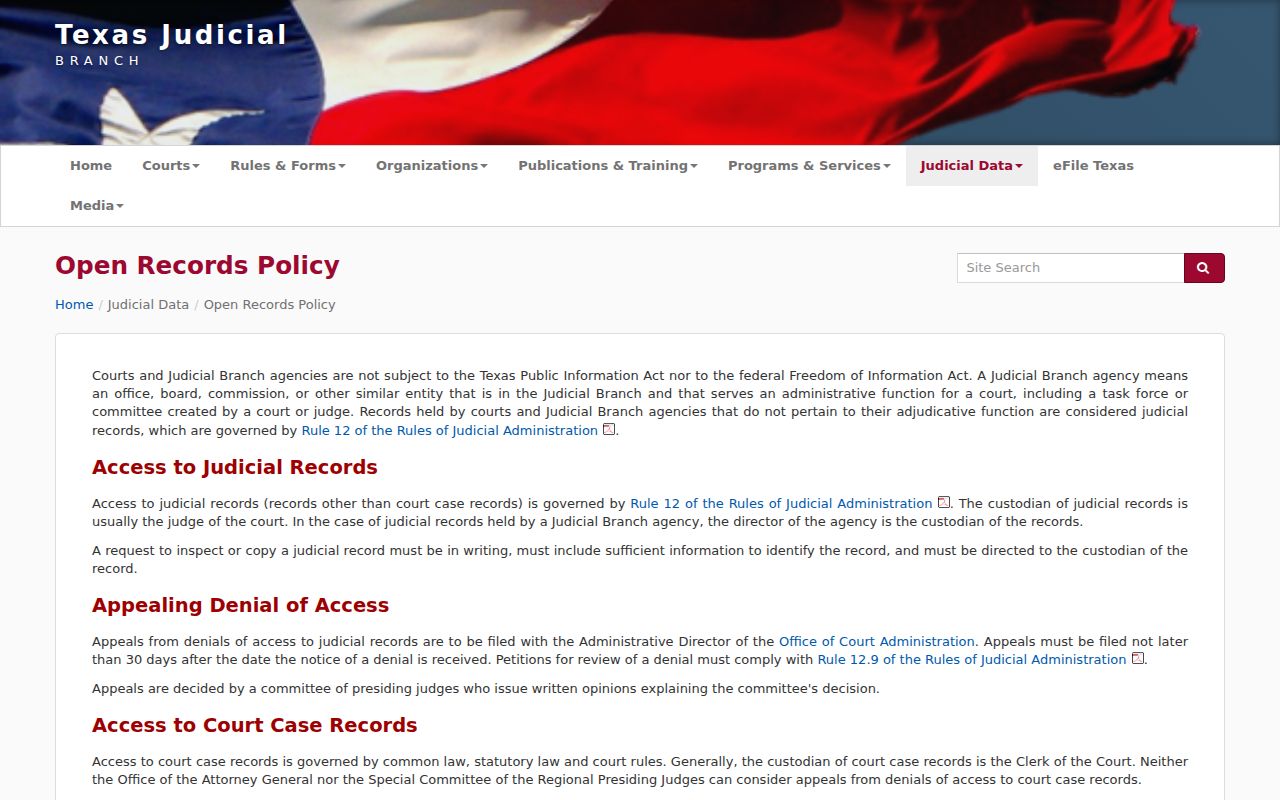
That screen points you toward the right route. It does not replace the clerk's case-file process in Loving County. Start by labeling what you want. It might be a pleading, a calendar entry, a clerk copy, an OCA report, or a judicial administrative record.
A case record takes the clerk and case number. A Rule 12 administrative record takes a written request. Give enough detail that the custodian can locate the document.
Public Access and Sealed Records
Public access does not put every Loving County court record on your screen. Some material stays closed for good reason. Texas Rule of Civil Procedure 76a governs sealing. Rule 21c covers sensitive data and redaction in filed documents. Family Code Chapter 58 protects juvenile information. Code of Criminal Procedure Chapter 55A governs expunction. The court or clerk draws these lines. A sealed case may simply be unavailable no matter where you search the docket.
Key Texas access rules:
Judicial Branch Open Records Policy and Rule 12 govern requests for judicial administrative records and explain why court case records may use a clerk-specific route.
Family Code Chapter 58 provides confidentiality rules for juvenile records.
Code of Criminal Procedure Chapter 55A provides the criminal expunction framework.
A blank search result is not proof that a record is gone. It only means the item is not publicly viewable through that channel. Ask what is really at work: sealing, confidentiality, redaction, thin system coverage, the wrong custodian, or a certification issue.
Loving County Rule 12 Requests
A case file and a judicial administrative record travel different paths. The Texas Public Information Act usually governs government records. Yet adjudicative court case files come from the clerk or the court's own process. Rule 12 supplies the Judicial Branch framework for judicial records. It covers written requests. It also covers exclusions for confidential or sealed material, and cases where disclosure would interfere with a judicial function.
Before you reach for an open-records label, decide what the target really is. It could be a pleading in a Loving County court case, a docket list, a clerk-held copy, an OCA statistical report, or an administrative record. That one choice tells you both the custodian and the rule. Chasing the underlying case? Use the case number and the Loving County clerk path. If it is a Judicial Branch administrative record, follow the official Rule 12 policy. Describe the requested record in enough detail for its custodian to locate it.
The distinction saves time and guards privacy. It also keeps a public calendar view from being mistaken for the complete, certified Loving County court record.
Loving County District Court Records
The 143rd Judicial District Court serves Loving, Reeves, and Ward Counties. A Loving County case can carry a hearing reference outside Mentone. It still remains a Loving County court record. Send any record request to the Loving County District Clerk. Use the Monahans administrator only to confirm the current hearing venue or schedule.
Loving County Appellate Court Records
An appeal opens a separate record stream. The official Texas appellate search takes a trial-court county and case number, so selecting Loving can tie an appeal back to its source case. Keep both numbers handy. An appellate order does not duplicate every trial exhibit, transcript, or sealed filing.
Loving County Federal Court Records
Federal matters tied to Loving County land in the Western District of Texas, Pecos Division, not the county clerk's archive. PACER and the federal clerk handle that docket path. County certification rates and re:SearchTX pricing simply do not apply to the federal file.
Loving County Court Record Snapshots
The posted district pretrial list and County Court docket are calendar snapshots. They give you a date and a case number, nothing more. Neither is a certified history. When an order, a final result, or the full filing sequence matters, ask the clerk. Ask for the underlying Loving County court record.
Loving County Court Record Redaction
Local sample rows carry names and case details. Court forms can go further, with addresses, birth dates, phone numbers, and license data. A public demonstration should crop those rows out. Send sensitive data only through a channel the Loving County court record custodian approves.
Loving County Court Record Transcripts
A transcript is not the same product as a docket sheet or clerk copy. For a 143rd District matter, give the case number and hearing date to the court administrator or reporter. Then ask for a current quote and delivery terms.
Loving County Court Record Certification
Portal access is fast, but a downloaded image is not automatically certified. Tell the clerk which document is needed and who requires it. The clerk can confirm whether a plain copy, a certified copy, or another official form fits that Loving County court record.