
How to Search Civil Dockets
Loving County posts no general civil search form of its own. The clerk points instead to Texas re:SearchTX. That statewide system can display eligible integrated cases, filings, document text, and hearings. You will need to register or sign in through eFileTexas. What you can see depends on court integration, document type, and the security matrix. If a search comes up empty, ask the clerk directly.
Work the other channels too. That means local docket links. It also means a call, the counter, mail, fax, and the clerk contact form. The County Court page carries docket links. Justice Court staff handle small claims, debt claims, and other limited civil work.
- Identify the court from the notice, claim type, or cause number.
- Search re:SearchTX if that court is integrated.
- Check the official County Court page.
- Call the proper clerk for current status and setting.
- Request the exact pleading, order, judgment, or certified copy.
Loving Civil Docket Lanes
Civil work here is split across courts. The 143rd Judicial District Court takes broad civil disputes, including land-title matters within its authority. Loving County Court lists civil and probate categories. Justice Court takes the smaller civil claims. Loving County has no County Court at Law and no municipal court.
| Court | Civil lane | Access |
|---|---|---|
| 143rd District | General civil and land title | District Clerk |
| County Court | County civil and probate | County Clerk |
| Justice Court | Small and debt claims | JP clerks |
The filed notice and the cause number control the case.
What a Civil Docket Shows
A civil docket is the running register of a case. Entries are added in order as things happen. Parties, cause number, filings, service, motions, settings, orders, and judgment can all appear there. Which fields show up online depends on the court and its access rules. The sample Loving County docket posted publicly was criminal. So no civil number format should be assumed.
| Cause number | The court file key. |
|---|---|
| Parties | Plaintiff, defendant, petitioner, respondent, or estate roles. |
| Filings | Petition, answer, service certificate, and other papers. |
| Motions | Requests and related rulings. |
| Settings | Hearings or trial events, subject to change. |
| Judgment | The filed resolution when public. |
The latest filed order, not an old web entry, controls.
Loving Small-Claims Answer Fields
The official Justice Court answer form shows that answering a small claim takes real work. It is more than a simple denial. The form asks for the cause number, party roles, precinct and place, defenses, added facts, requested relief, a signature, contact details, and a certificate of service. That certificate records how the other side got the filing.
The form also offers jury and remote-appearance choices. A $22 jury fee is due at least 14 days before trial. The fee is waived if the form is filed with a Statement of Inability to Afford Court Costs. Note the fee belongs to that form, not to every Loving County civil filing.
Remote appearance is only a request. Jury trials are left out of the remote choices. The court must approve anything anyway.
Types of Civil Cases on the Docket
Civil cases in Loving County land in different courts depending on type. District jurisdiction reaches broad claims and title-to-land disputes. County Court carries civil and probate categories. Justice Court separates debt claims, landlord and tenant claims, and small claims into their own groups. The category decides the custodian and the form.
- General district civil disputes
- Land-title litigation
- County Court civil matters
- Probate and estate files
- Justice Court small claims
- Justice Court debt and other limited claims
One directory lists family as "no" for Loving County Court. That field only describes this court's caseload, not the whole Texas court structure, so family matters could still exist elsewhere.
Loving Land Records Are Separate
LovingTXRecorder indexes recorded instruments and land records within its stated scope. It is not a Loving County civil docket. A deed or lien may connect to a lawsuit, but it is not the petition, the motion, the hearing entry, or the judgment.
| System | Contains | Does not replace |
|---|---|---|
| LovingTXRecorder | Recorded instruments | Civil pleadings |
| re:SearchTX | Eligible court records | Clerk certification |
| Clerk file | Official releasable filings | Land index |
Use LovingTXRecorder only when a recorded instrument is what you need.
Settings and Hearings on Civil Dockets
A civil setting might be a motion hearing, a pretrial conference, a trial, a probate matter, or another ordered event. Confirm the court, time, venue, judge, and setting type. A reset moves a setting without erasing the case. A continuance is a court-approved delay, not a judgment.
County Court meets on a second-Wednesday practice, but its own instructions say to call for a docket date. District matters run through the multicounty 143rd administration. JP location references conflict among the Community Center, courthouse text, and an old Hopper Annex form, so call before you drive. The Loving County court calendar offers a broader way to verify.
Loving Civil Docket Image
The official Texas court directory source helps you confirm the court type and custodian for routing Loving County civil and probate matters.
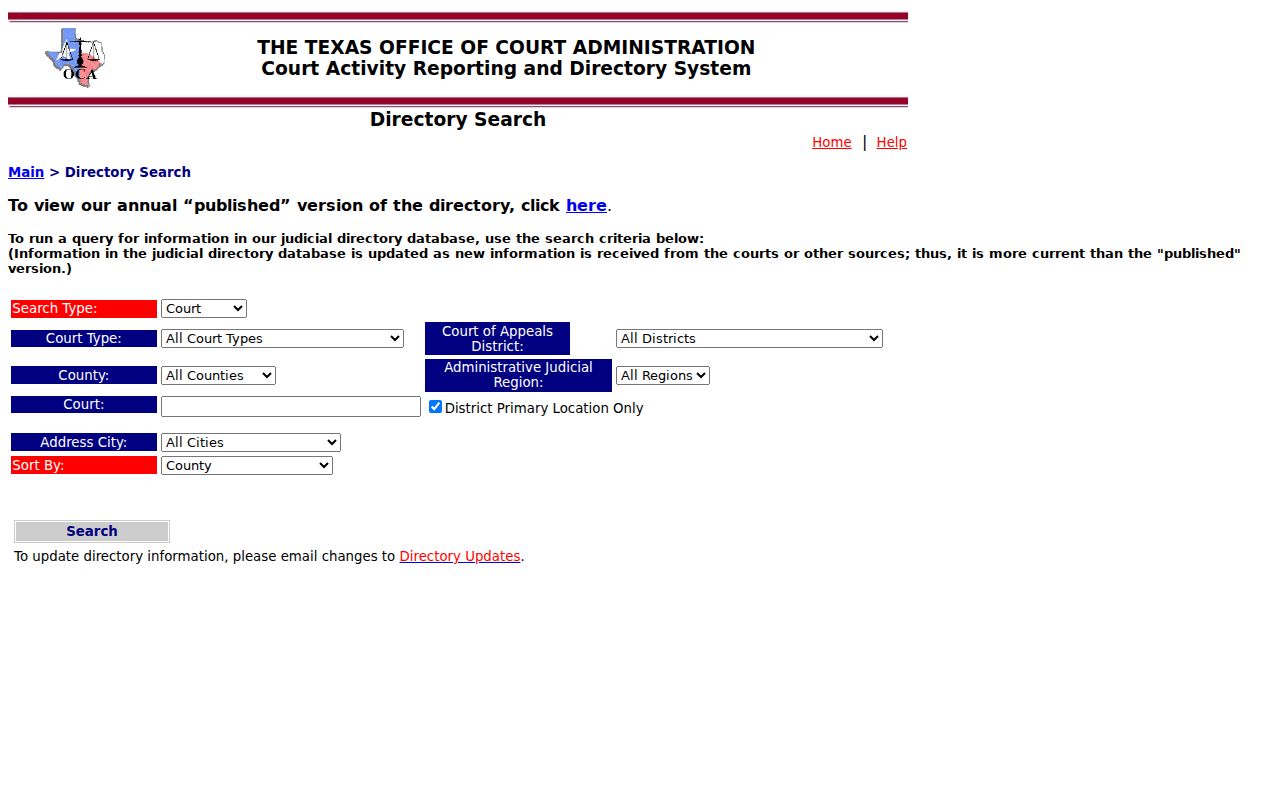
The directory lets you filter by county, court type, court, address city, and sort order. It routes inquiries without exposing party-level docket rows.
Loving Probate Copy Requests
Loving County publishes no probate index or probate search form. Start with the County Clerk. Give the estate or decedent name, an approximate filing date, the court, and the cause number if you have it. Say exactly which paper you want. That could be a docket sheet, application, order, inventory if public, judgment, or something else.
Tell the clerk whether you need a plain or certified copy. Certification adds the clerk's formal seal of accuracy. The published schedule gives general copy references, but separate civil and criminal schedules exist. So the clerk must confirm probate costs for your case.
Ask for a specific document rather than "the probate record." One file can hold several applications, notices, inventories, bonds, orders, or later filings. Some material may be redacted or closed to the public. Before mailing any payment, ask a few things. Find out whether an electronic copy is possible. Ask whether paper certification is required, and how payment should be made.
Loving Civil Workload Context
The Justice Court files workload summaries with the OCA. They are not case searches. October 2024, for instance, showed one small claim pending in the displayed category. January 2026 listed two small claims pending at the start and end. That month also showed one new debt claim and one debt claim pending at month end. Nothing in either report identifies a party, a merit, or a result. The figures describe categories and months only.
These totals tell you nothing about any party or the merits. For a specific matter, use the case file. Do not add the monthly categories into a live total either. A case can begin before the reporting month. It can sit inactive, reactivate, or be disposed in a later period. Comparing reports shows broad workload movement, but it cannot replace the docket history. Cite the report month whenever you quote an OCA figure. For the status of a named cause, ask the Justice Court clerk.
Loving Civil Copy Costs
Under the April 1, 2025 schedule, the clerk charges $1 per page for paper copies. Certification costs the copy rate plus $5 per document. Electronic copies follow separate listed terms. Civil, criminal, and other case fees sit apart from these rates. So ask which one applies before you pay.
The $25 first-page total belongs to recorded instruments, not a civil filing. re:SearchTX purchases run on statewide terms. Keeping these fee channels straight avoids a common Loving County docket error.
Public Access to Civil Dockets
Public civil records can still hold sealed or redacted material. Texas Rule of Civil Procedure 76a governs sealing court records. Rule 21c addresses sensitive data. A portal may show metadata but not every image. Ask the clerk about any missing item. It may be sealed, restricted, awaiting redaction, unavailable in that system, or held elsewhere.
Access distinction: The Judicial Branch Open Records Policy explains that case records use the clerk or court process, while Rule 12 applies to certain administrative judicial records. The Texas Public Information Act does not govern court case files like many agency records.
Give just enough facts to identify the file. Never send excess sensitive data, and never try to bypass a seal or restriction.
Loving Clerk Civil Requests
Mozelle Carr serves as Loving County & District Clerk. The current listing is PO Box 194, 100 Bell Avenue, Mentone, TX 79754. Call 432-309-9500 extension 6, or fax 432-789-2194. Hours run Monday through Thursday, 8:00 a.m. to 5:00 p.m., plus Friday, 8:00 a.m. to noon.
- Identify district, County Court, probate, or JP.
- Give the cause number or narrow description.
- Name each filing or order.
- Choose plain or certified copies.
- Confirm fees, redaction, and delivery.
For Justice Court records, call JP staff at 432-286-9544. District schedule questions go to the administrator, but district file requests stay with the District Clerk.
Loving Civil Appeals Split
An appeal gets its own appellate docket and number. The Texas appellate search lets you filter by Loving as the trial county. You can also enter the trial case number. The Eighth Court of Appeals is the relevant intermediate court when it has jurisdiction.
Keep both numbers handy. Trial pleadings stay with the trial custodian. The appellate file holds the briefs, orders, and opinions. Search first by trial-court county and number. Then note the new appellate number and case style. An appellate opinion or order may resolve a point on review without reproducing exhibits, transcripts, or every trial filing. Those items may still need a request elsewhere. Try the District Clerk, the court reporter, or the appellate clerk.
Civil appeals and federal cases diverge too. A federal civil case arising in Loving County belongs to the Western District of Texas, Pecos Division. It uses PACER or CM/ECF. Local events alone never make it a county civil case. The court name on the notice is the safest routing clue.